What does IESE actually look for as an MBA application moves from written materials to video assessment, interview, Assessment Day and finally the admissions committee?
In this MBA Insider Interview, Jesse Lambdin, co-founder of MBA Commons and Top MBA Consultants, speaks with Tomofumi “Tomo” Nishida, then Deputy Director of MBA Admissions at IESE Business School.
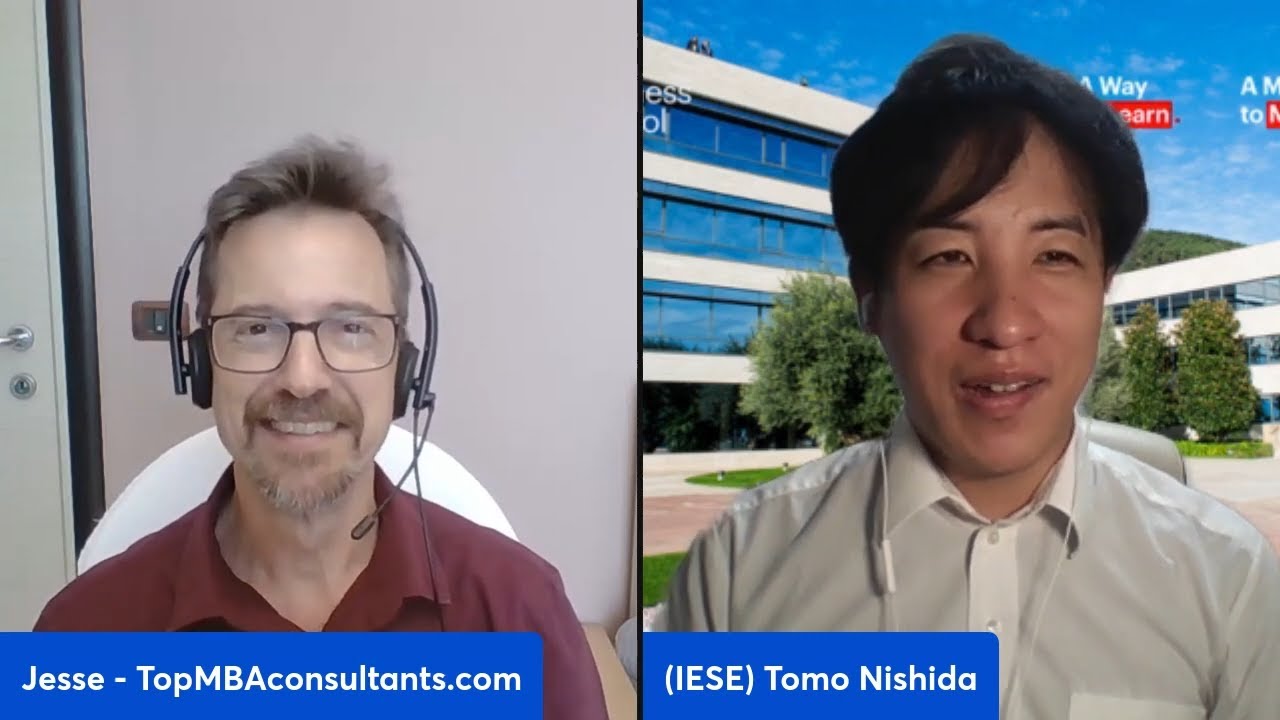
Tomo walks through almost the entire admissions journey, including what applicants should do before applying, how he reads essays, what makes a résumé effective, recommendations, video responses, interviews, Assessment Day, waitlists and what can happen inside an admissions committee meeting.
The interview was recorded for an earlier admissions cycle, so some mechanics have since changed. The admissions thinking underneath them is what lasts.
Cycle note: The interview was released as IESE prepared to open applications for the MBA 2025 intake (Class of 2027). Use it for admissions philosophy, evaluation logic and preparation insight, and check current IESE guidance for today’s prompts, video-assessment mechanics and Assessment Day logistics.
Watch the interview by topic
00:00 - Introductions
03:14 - ChatGPT and AI in applications and business school
04:57 - Laying the groundwork for a strong application
05:42 - Why researching schools matters
12:22 - Tomo analyzes an example career-goals essay
23:15 - What if you are uncertain about your post-MBA career?
29:54 - Essay advice for non-native English speakers
34:11 - What makes a résumé stand out?
36:41 - Letters of recommendation
45:30 - Video assessment format
48:28 - How video responses are evaluated
50:29 - Should you use notes around your computer?
51:57 - Example of a poor video response
52:32 - What makes a good video answer?
54:57 - IESE interviews
57:20 - Interview style and structure
1:02:06 - Common interview questions
1:11:10 - Assessment Day
1:20:52 - Good and bad case-discussion performance
1:22:29 - Preparing for Assessment Day
1:24:42 - Holistic application evaluation
1:26:11 - What happens inside admissions committee meetings?
1:29:52 - How IESE may distinguish similar applicants
1:31:56 - Waitlist advice
1:34:01 - Requests for an early decision
Before you apply: understand yourself first
Tomo’s first recommendation is not about essays, GMAT or networking.
It is self-understanding.
Applicants need to know themselves both professionally and personally.
He also argues that this work is difficult to do in isolation.
Colleagues, friends and family members may recognize patterns in your motivations, strengths and behavior that you overlook.
That self-analysis then becomes the foundation for school research.
Without it, you can collect endless facts about a program and still struggle to explain why any of those facts matter to you.
How deeply should you research an MBA program?
Very deeply.
Tomo encourages applicants to compare multiple schools rather than studying one in isolation.
Understanding School B can help you understand what is genuinely distinctive about School A.
He also recommends firsthand conversations with people connected to each program, including students and alumni.
At one point he suggests speaking with roughly five people from each school as a useful benchmark.
The number itself is less important than the principle:
Do not rely only on rankings, websites and institutional messaging.
Learn what the program feels like from people who have actually lived it.
Should you contact admissions before applying?
Only when there is a reason.
Tomo does not treat contact with admissions as a box applicants need to check.
He himself did not have an informal pre-application admissions conversation when he applied to IESE.
If your questions are already answered, creating an unnecessary interaction does not earn points.
But if you have a genuinely admissions-specific question, contact can be useful.
Examples might include:
- whether your particular score profile suggests applying in one round rather than another;
- something difficult to understand from public employment data; or
- a concern specific to your own candidacy.
The key is relevance.
Quality of school engagement matters more than raw quantity
The application used at the time asked about interactions with students, alumni, admissions staff and school events.
Would checking every possible box impress Tomo?
Not necessarily.
He says the quality of the interaction can matter more than the number.
One meaningful conversation that materially changes your understanding of IESE can be more persuasive than 20 shallow contacts.
And simply dropping a list of alumni names into an essay is not evidence of fit.
Explain what you learned and why it mattered.
Tomo analyzes an IESE career-goals essay
Starting around 12:22, Tomo critiques a fictional career-goals essay he created for the interview.
His first concern is relevance.
The sample opens with personal background that may be interesting but does not directly answer the actual question.
With only 300 words available at the time, every paragraph had to earn its space.
He wants the applicant to focus on:
- short-term goals;
- medium-term goals; and
- how IESE will help achieve them.
Specificity is good, but only when it is relevant
Tomo likes that the fictional candidate specifies:
- location;
- industry or sector;
- function; and
- even a target employer.
He also likes that the essay refers to an alumnus the candidate had spoken with.
Where the essay becomes weaker is in naming an IESE course without clearly showing why that course matters for the stated goals.
That is a crucial distinction.
Specificity is not the same as relevance.
Name-dropping a club, course or professor does not strengthen an essay unless the connection makes sense.
What if you genuinely do not know your post-MBA career?
Tomo’s answer should reassure applicants.
A hypothetical but coherent goal is acceptable.
IESE understands that people change direction during an MBA.
What becomes difficult is trying to fit multiple unrelated possibilities into a short essay.
If consulting excites you more than fintech right now, it may be better to build one credible consulting story while recognizing internally that your actual career may evolve later.
The application is not a binding contract with your future self.
It is evidence that you can think intentionally about where you are going and why IESE is relevant.
Should non-native English speakers make their essays grammatically perfect?
Tomo says yes, written material should still be grammatically correct.
But he also makes a larger point.
With tools such as ChatGPT, polished grammar tells the admissions committee much less than it once did.
He therefore places greater value on communication that is harder to outsource, particularly live verbal interaction.
That matters at IESE because the case method requires students to participate in fast-moving classroom discussion.
IESE also adjusts expectations to account for the reality that applicants come from many linguistic backgrounds.
The school is not trying to create a class composed only of people who sound like native English speakers.
What makes a strong IESE résumé?
Tomo separates content from format.
Content
Be specific about:
- actions;
- responsibilities; and
- accomplishments.
Numbers can be particularly useful when they clarify scale or results.
Format
Tomo strongly prefers a one-page résumé, even though the school permitted two pages at the time.
He explains that IESE students later have to work within a standardized one-page CV format for recruiting, so applicants may as well begin learning how to prioritize information.
The lesson is not simply “make the font smaller.”
A one-page résumé forces judgment about what matters.
How important are recommendation letters?
Tomo does not assign a simple percentage.
Instead, he pays attention to consistency between the recommendation and the rest of the candidacy.
Recommendations can also generate interview questions.
If a recommender raises something interesting, surprising or concerning, the interviewer may want to explore it.
How should applicants work with recommenders?
Give them time.
Discuss why you are pursuing an MBA.
Make sure the recommender understands enough of your goals and experiences to write meaningfully.
Where possible, avoid unnecessary repetition between the recommendation and other parts of the application.
But Tomo also recognizes that some overlap is natural, especially for applicants with shorter work histories or one particularly important long-term project.
The goal is not to choreograph two completely separate fictional stories.
It is to let another person provide an independent perspective.
Should you ghostwrite your own recommendation?
No.
Tomo is unambiguous that applicants should not write the recommendation on behalf of the recommender.
If language is the concern, translation support is preferable to having the applicant become the author.
His practical advice for preventing the common “I’m too busy, you write it” problem is to approach the recommender early enough that time pressure is less credible as an excuse.
IESE video assessment: what the older recording tells us
This is a section where cycle context matters enormously.
Tomo explains the video format being used for the MBA intake discussed in the interview, including an introduction and randomized questions with limited preparation and response time.
He also explains why IESE had increased its use of video:
written material had become easier to polish or generate with AI, so live communication offered another way to understand the applicant.
The exact question count and format should not be treated as current merely because it appears in this recording.
IESE has continued changing the video component. Applicants should use the current IESE application guidance for their cycle.
How did Tomo evaluate video responses?
He focuses on two broad areas:
communication and authenticity.
Communication includes more than English proficiency.
Can you structure an answer?
Can someone follow the logic?
Can you make the important point within the time available?
Authenticity means that the response feels grounded in the applicant’s actual experience rather than something generic that could have been generated for anyone.
Should you put notes around your screen?
Be very careful.
Tomo says the admissions committee can notice when someone’s eyes are repeatedly moving away from the camera.
The worst example he remembers was an applicant essentially reading a script throughout the answer.
No matter how polished the content was, it created a negative impression.
A quick glance at a minimal reminder is very different from reading.
But the safer preparation strategy is to know your stories well enough that you do not need a script.
What makes a strong video answer?
Tomo likes answers that are easy to follow.
One possible structure is:
start with the central point or keyword, then support it with a real episode.
That gives the evaluator orientation immediately and then evidence.
The exact structure matters less than clarity and authenticity.
What is an IESE MBA interview like?
At the time of the recording, Tomo describes an interview lasting roughly an hour, conducted either online or in person.
He says the format did not affect the final evaluation.
Interviews could be conducted by admissions committee members or carefully selected alumni.
Most importantly:
the interview was not blind.
The interviewer had the applicant’s full information, including the video assessment.
That means the conversation could probe inconsistencies, unclear points or interesting details already found elsewhere in the file.
IESE interviews can be highly conversational
Tomo describes his own interview style as more conversational than a rigid question-and-answer sequence.
He often does not prepare a long list of questions.
Instead, he listens carefully to the answer and builds the next question from what the applicant just said.
That is why over-rehearsed answers can be counterproductive.
If your mind is focused on delivering the next memorized paragraph, you may stop participating in the actual conversation.
How long should an interview answer be?
Concise enough to create dialogue.
Tomo compares it loosely to talking with someone you know well.
If you speak for five uninterrupted minutes every time someone asks a question, the conversation becomes exhausting.
He generally prefers answers that get to the point and then leave space for follow-up.
That does not mean every answer must be 30 seconds.
It means the applicant should remain aware that an interview is an interaction, not a speech competition.
“Tell me about yourself”
Tomo sees this partly as a comfort-building question.
He is not necessarily expecting dramatic new information because he has already read the application.
That is another reason not to turn it into a five-minute autobiography.
Give the interviewer a clear, concise frame for the person they are about to speak with.
Behavioral questions and STAR
For questions such as “Tell me about a time you led a team,” Tomo says STAR can be useful:
Situation, Task, Action, Result.
But he particularly wants applicants to emphasize their own actions.
Context matters only insofar as it helps the interviewer understand what you actually did.
Answer the question you were asked
This sounds obvious, but Tomo sees applicants trying to force a prepared story into a question it does not really answer.
If the interviewer asks about conflict, give an example that genuinely involved conflict.
If asked about weakness, discuss an actual weakness.
A beautifully rehearsed story that misses the question is still a weak answer.
Do not disguise a strength as your greatest weakness
Tomo specifically discusses the classic “I’m a perfectionist” answer.
The problem is not that perfectionism can never be a real weakness.
It is that applicants often choose it because they are afraid to reveal anything genuinely negative.
The better principle is relevance and authenticity.
If the question is about weakness, the interviewer should hear a real weakness.
Which other MBA programs did you apply to?
Tomo says transparency is generally appreciated.
There is no universal perfect answer because the meaning of the question depends on the applicant’s context.
A sponsored applicant may logically need to apply to several schools.
Another person may genuinely be applying to only IESE.
What matters is that the explanation makes sense given the rest of the candidacy and the interactions the school has already had with that person.
What is IESE Assessment Day?
Tomo describes Assessment Day as a way to observe capabilities that are difficult to capture in a one-to-one interview, especially:
- teamwork;
- class participation;
- communication; and
- behavior in a group.
At the time, Assessment Day could involve a business case or another collaborative problem, depending in part on faculty availability.
The underlying objective was to approximate parts of the IESE classroom and team experience.
That means applicants were evaluating IESE at the same time IESE was evaluating them.
If you strongly dislike the experience, Tomo essentially asks whether you would actually enjoy studying in a program built around similar dynamics.
How does a case-based Assessment Day work?
In the format Tomo describes, applicants received the case before the event and had time to prepare.
During the day, candidates moved between smaller group discussions and a larger room.
Small groups might contain roughly six or seven other applicants plus an IESE observer.
That observer was not there to play a role in the case.
The observer was primarily watching how the team worked and how individuals contributed.
Groups then returned to the larger discussion, often led by a professor, and the process could repeat.
What makes a strong Assessment Day participant?
Tomo emphasizes the balance between quantity and quality.
Being completely silent is risky.
But speaking constantly does not automatically produce a strong evaluation either.
Someone from a more reserved communication culture may contribute less often but add something thoughtful each time.
IESE tries to account for those differences.
The target is not to become the loudest person in the room.
It is to contribute meaningfully to the group’s thinking.
How should you prepare for Assessment Day?
Tomo suggests several practical strategies.
Experience an IESE Open Day or another case discussion beforehand if possible.
Get comfortable participating in group conversations with people from cultures different from your own.
If you rarely speak English in groups, deliberately create situations where you have to do so before Assessment Day.
And if the exercise uses a business case, do the analytical work rather than relying only on qualitative observations.
He notes that candidates often neglect the numbers, which can create an opportunity for someone who has actually done the quantitative analysis.
How does IESE evaluate the entire application?
Tomo stresses that the process is holistic and difficult to reduce to exact percentages.
But when pressed to identify particularly important areas, he gives four broad pillars:
- Professional and personal trajectory
- Why IESE and overall fit
- Communication ability
- GMAT/GRE
He describes them as more or less equally important while emphasizing that other evidence is still considered.
This is useful because it shows why there is no single magic application component.
A strong test score cannot compensate for everything.
Neither can a beautiful essay.
Neither can one excellent interview.
What happens inside an IESE admissions committee meeting?
Tomo describes regional committees as well as a broader scholarship committee.
Regional organization helps the admissions team evaluate candidates with enough contextual knowledge while also managing the diversity of the eventual cohort.
Some candidates require very little discussion because the decision feels straightforward.
Others can generate several minutes of debate because the evidence is more mixed.
The objective is not to spend equal time on everyone.
It is to spend enough time to make the difficult decisions well.
What can separate two otherwise similar applicants?
Sometimes cohort composition matters.
If one nationality or professional background is already heavily represented, another applicant can add a different dimension to the class.
Tomo also points to something applicants can influence:
the depth of the applicant’s genuine connection to IESE can matter.
If two candidates are otherwise very similar, the one who clearly understands the school and has demonstrated thoughtful engagement may have an advantage.
Again, quantity alone is not the point.
Twenty shallow conversations do not automatically equal one meaningful connection.
What should you do if IESE waitlists you?
Tomo acknowledges how frustrating the uncertainty can be.
IESE did not provide detailed individual feedback explaining exactly why someone had been waitlisted.
He also explains that not all waitlisted candidates were in the same position and that the eventual outcome could depend partly on what happened in later application rounds.
His practical recommendation is to provide meaningful updates from time to time so the school knows you remain interested.
Can you ask IESE for an early decision?
If another school’s deposit deadline creates a conflict, Tomo says applicants can ask.
There is no guarantee IESE can accelerate the decision.
The school may instead suggest asking the other program for a deadline extension.
The best prevention is to map the timelines of all schools before applying.
But when conflicts still arise, communication is reasonable.
What lasts beyond this admissions cycle
The durable themes are broader than any one cycle’s mechanics:
Know yourself.
Research the school deeply.
Be relevant.
Be specific.
Communicate naturally.
Do not substitute polish for substance.
And remember that IESE is evaluating how you are likely to contribute to a highly interactive community, not simply whether you can construct a technically perfect application.
Continue exploring IESE
Read the MBA Commons IESE Business School MBA Guide for current application requirements, program structure, careers, costs and student life.
Applied to IESE recently? Some of the mechanics in this recording have changed, and recent applicants are the best guide to how they work now. Reply below with your application year and what you found: how the video assessment was set up, what your interview felt like, and how your Assessment Day was structured. Please don’t share any questions you were asked to keep confidential.